
What is Skin Cancer?
Skin cancer is caused by damaged DNA in skin cells. These damaged cells then produce other cells with the same damages, and this collection of damaged cells is what we call skin cancer.
There are three main types of skin cancer:
- Basal Cell Carcinoma (BCC)
- Squamous Cell Carcinoma ( SCC)
- Melanoma – the most dangerous form of skin cancer
Both Basal Cell Carcinomas (BCC) and Squamous Cell Carcinomas (SCC) are known as non-melanoma skin cancers. The cause for these cancers is damage to the basal and squamous skin cells, which are located in the top few layers of your skin. Melanoma is caused by damage to melanocyte cells, which are located in the deeper layers of your skin.
Excluding non-melanoma skin cancer, melanoma is the third most common cancer in Australians. Skin cancer accounts for 80% of all newly diagnosed cancers, meaning Australia has the highest rate of skin cancer in the world, two to three times the rate in Canada, the US and the UK. Approximately two thirds of Australians will be diagnosed with skin cancer by the time they turn 70, with men being diagnosed almost twice as much compared to women. In 2025, 17,443 Australians were diagnosed with melanoma. In the same year, melanoma caused the death of 1,455 Australians.
Symptoms of Skin Cancer
Australian GPs perform over a million skin checks every year, and regular checks reduce your risk of developing advanced stage melanoma. Your doctor can advise you on ways to protect yourself, and how to identify potential skin cancers. You should become familiar with the look of your skin, so you can pick up any changes.

Causes of skin cancer
Anyone can develop skin cancer. People with fair skin, family history, and exposure to UV radiation are the most vulnerable, with the risk increasing as you get older. The most common cause of skin cancer is overexposure to ultraviolet (UV) radiation from the sun, which causes 95% of melanomas.
Sunburn
In Australia, there are around 2.26 million cases of sunburn every year, which averages to around 6,200 cases everyday. It can take just 10-15 minutes of unprotected sun exposure to get a sunburn, occurring most often during outdoor activities such as swimming, gardening, and outdoor gatherings. Sunburn can happen even on cooler or overcast days as despite popular belief, UV radiation is still just as strong in cooler weather. Sun exposure that doesn’t result in burning can still cause damage to skin cells and increase your risk of developing skin cancer.
Tanning
Tanning occurs when you are exposed to enough UV radiation (from the sun or tanning bed) to damage your skin. This will eventually cause loss of elasticity (wrinkles), sagging, yellowish discolouration and even brown patches to appear on your skin. Worst of all, it increases your risk of skin cancer. A tan only offers very limited protection from sunburn, usually equivalent to SPF3 depending on your skin type. It does not protect from DNA damage, which can lead to skin cancer.
Diagnosis for Skin Cancer
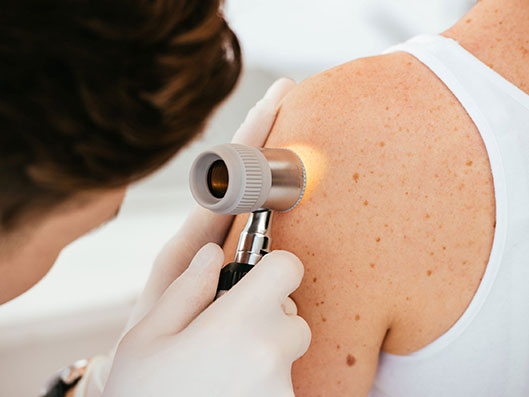
It is important to check your skin regularly and check with your doctor if you notice any changes. It is recommended to have a whole body skin check performed every twelve months, unless otherwise stated by your GP. It is the best way to prevent death as many skin cancers, including melanoma, are not always visible to the naked eye, appearing just like a normal mole.
What is a Whole Body Skin Check?
At Grace Medical Skin and Vein Centre our experienced Doctors use a special device called dermoscope, which magnifies the mole/skin lesion about 10 times. An expert can identify a skin cancer by looking at the various features of the lesion. Sometimes the lesions or moles need to be monitored periodically (3 monthly or 6 monthly) to see if there is any change. We also use a Mole Scan Software (Dermdoc) is specialised computer software for computer assisted skin scanning. It allows our GP’s to get instant information, allowing for a more accurate risk assessment than regular mole scanning techniques. It also allows us to take high-resolution images of a moles, with 30-40 times magnification. These images are then stored and used for periodic monitoring and comparison.
What happens after a Skin Check?
If your GP finds anything of concern, they will decide either to monitor or to perform a biopsy. A biopsy is where we send a small part of lesion away for microscopic examination. Once we have the results of the biopsy, we will formulate a treatment plan.
Treatment for skin cancer
Skin Cancer Surgery
Skin cancers will be removed in almost all cases. In the case of more advanced skin cancers, we may remove some of the surrounding tissue as well, to make sure that all of the cancerous cells have been taken out. Aggressive skin cancers, like melanoma, may need wider excisions. Skin cancers in delicate areas, such as the face, may need more advanced excision techniques, as well as more complicated repair, such as skin flaps or skin grafts. We can perform all of this here at Grace Medical Skin and Vein Centre.
Chemotherapy Creams
Some types of skin cancers can be treated with topical chemotherapy creams. These creams work by destroying skin cancer cells and disrupting the production of new cells, stopping the spread. This type of treatment may need up to 4-5 weeks to prove effective.
Photo Dynamic Therapy (PDT)
Some non melanoma skin cancers can be treated by UV rays after applying photosensitive creams on the lesions
Radiotherapy
Some Skin cancers can be treated by fractionated radiotherapy
Preventing skin cancer
Protect your skin
Please be extra cautious when going out in the sun. UV levels are most intense during the middle of the day, but exposure in the mornings and evenings can also cause skin damage. For best protection, when the UV level is 3 or above, we recommend the Cancer Council Slip, Slop, Slap, Seek and Slide:
Slip on some sun-protective clothing. It should cover as much skin as possible, and not allow sunlight through the fabric.
Slop on broad spectrum, water resistant sunscreen. Put it on 20 minutes before you go outdoors and every two hours afterwards. Sunscreen should have a SPF rating of at least 30, and should never be used to extend the time you spend in the sun.
Slap on a hat. Make sure it protects your face, head, neck and ears
Seek shade. If you will be spending an extended amount of time in the sun, find a spot protected from direct sunlight.
Slide on some sunglasses. UV rays can also have negative effects on your eyes. Make sure they meet Australian standards for blocking UV rays.
